A category defined by Accepto Technologies — and the clearest explanation of it on the internet. Not a marketing term borrowed from someone else’s playbook, but a discipline named because we saw it emerge, years before anyone had a word for it. This page exists to answer every question a serious operator, analyst, or partner would ask about what AI Operational Intelligence actually is. Read it once, and you’ll recognize the gap it describes in your own business.
What is AI Operational Intelligence
AI Operational Intelligence (AOI) is the practice of using AI to continuously understand the operational reality of a business — its documents, communications, exceptions, and decisions — as they occur, independent of and prior to their entry into a System of Record. It sits above the ERP, not inside it as a bolt-on, and not beside it as a separate app to babysit. It is a layer of understanding, not a ledger of record.

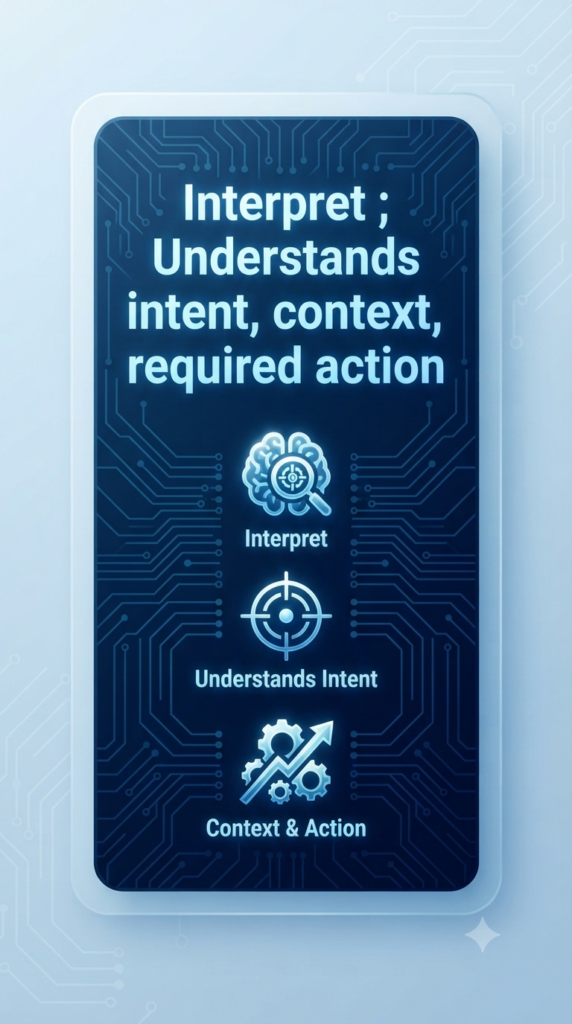
Three properties define it. It is contextual, not rule-based — interpreting meaning the way a skilled operator would, reading a certificate, a negotiated email, or a Shopify order note for what it actually means, rather than executing a fixed script. It is continuous, not periodic — it doesn’t wait for a batch job or a month-end close; it understands operations as they happen, in real time. And it is compounding, not static — the longer it runs inside a business, the more operational nuance it understands, and the more it can be trusted to act.
Why AI Operational Intelligence
Every operating business generates two parallel realities. One is recorded — inventory counts, invoices, journal entries — and lives inside the ERP. The other is lived — the emails that set the price, the certificate that proved authenticity, the WhatsApp message that changed the delivery date — and until now, it has lived nowhere except in the heads of the people who handled it.
That second reality is where operational risk actually originates. Stockouts, compliance failures, margin erosion, and customer disputes rarely begin with a bad transaction. They begin with something true in the business that never made it into the system that was supposed to track it.
AI Operational Intelligence exists to close that gap — not by asking humans to type faster, but by giving the operational layer of the business the same intelligence its financial layer has always had.

How AI Operational Intelligence will help
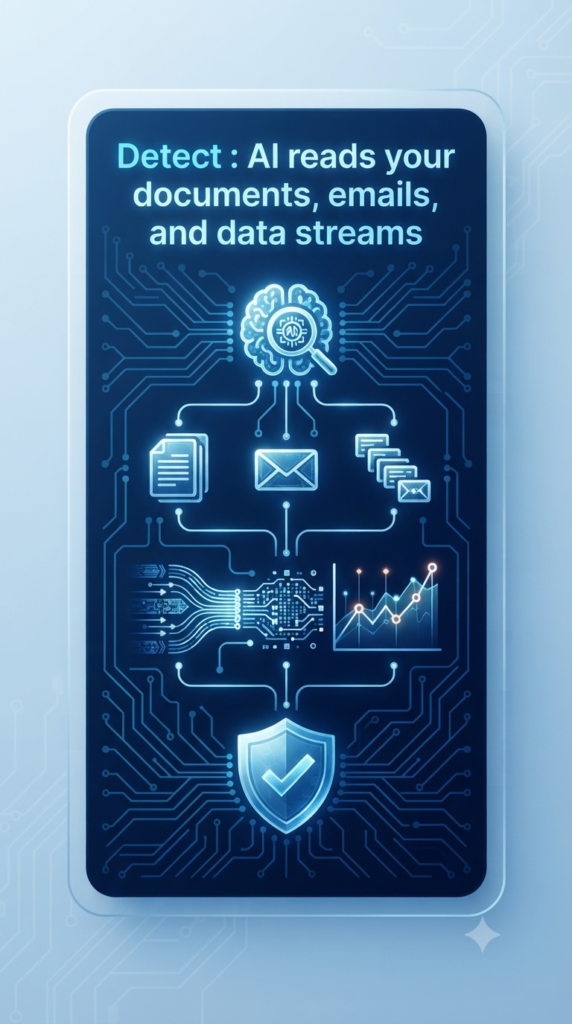
AI Operational Intelligence works by continuously reading and reasoning across the channels where operations actually occur — documents, inboxes, marketplaces, messaging — and translating what it understands into structured, trustworthy input for the System of Record.

It does not replace human judgment on exceptions that genuinely require it. It removes the far larger category of work that never needed human judgment in the first place — the reading, matching, re-typing, and reconciling — so that human attention is spent only where it creates value.
Why Now?
Two curves crossed. AI models became capable enough to reliably understand unstructured business context — documents, language, intent — rather than just classify or predict within narrow rules. At the same time, operational complexity kept compounding: more channels (Shopify, WhatsApp, marketplaces), more documentation (certificates, compliance, provenance), more speed expected by customers who no longer wait for manual reconciliation.

ERPs matured to handle the first curve decades ago. Nothing matured to handle the second — until AI Operational Intelligence became technically possible. Now it is not only possible; for operations-heavy, document-dense industries, it’s become necessary.
The Operational Maturity Model
It starts with Operational Friction, where reality and the ERP disagree constantly and humans are the reconciliation layer. From there, a business gains Operational Intelligence — a system that understands operational reality as it happens. That understanding produces Operational Confidence, where decisions are made on information known to be current and correct, not assumed. Confidence frees up Operational Capacity, as teams stop spending hours reconciling and start spending hours deciding. And at the far end sits Operational Maturity — the stage where operational friction is structurally minimized, not manually managed.


BUSINESS CENTRAL + SHOPIFY
Business Central remains the System of Record. Shopify, and channels like it, generate operational reality faster than any team can manually reconcile. AI Operational Intelligence is the layer that keeps the System of Record accurate without asking a human to be the translator between the two, transaction by transaction, forever.
Future
As AI Operational Intelligence matures inside a business, it earns increasing autonomy — starting with understanding, moving to recommendation, and eventually to trusted action on well-understood, low-risk operational decisions, always within boundaries the business defines. The endpoint is not a business with less human judgment. It’s a business where human judgment is spent only on what actually deserves it.

LET’S CREATE
EXCELLENCE
THAT LASTS FOREVER
Share your vision with us and our experts
will craft the perfect solution for your business.

Industry Expertise
Deep knowledge of your business

Precision & Quality
Delivering measurable results

Trusted Partnership
Your growth is our commitment